Guest Interview With Thorne Moore
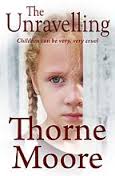 Today, I’m thrilled to be chatting to author, Thorne
Moore. Those of you who read my blog will know I'm a big fan of Thorne's previous books and I was eagerly awaiting her third novel. ‘The
Unravelling’ was published by Honno on Thursday 21st July and
I’m so pleased she has agreed to appear on my blog.
Today, I’m thrilled to be chatting to author, Thorne
Moore. Those of you who read my blog will know I'm a big fan of Thorne's previous books and I was eagerly awaiting her third novel. ‘The
Unravelling’ was published by Honno on Thursday 21st July and
I’m so pleased she has agreed to appear on my blog.
Thorne, welcome.
Thank you for asking me, Jan.
It’s a pleasure.
Please introduce yourself and tell
us a little about your writing.
Well, I grew up in Luton,
which I have milked remorselessly for settings for my books, and after studying
history at Aberystwyth university, I worked in Luton library for a while. Then
I moved to Pembrokeshire, where I ran a restaurant with my sister.
Pembrokeshire provides another setting for my books. I’ve run a business for
years making miniature furniture (hand carved Tudor furniture for dollshouses),
but now, more and more, I am concentrating on writing, which is all I ever
really wanted to do.
Can you tell us what inspired you to write ‘The Unravelling’?
Mostly it was the setting –
the estate in Luton where I grew up. Which sounds a bit absurd,
being inspired
by a very ordinary council estate, but when you are young, the place you live
can have all sorts of undertones that lurk in your subconscious, even a very
ordinary council estate. I was remembering my walks to and from school, with
the myths we children concocted, like killer leeches in the culverts, or
witch’s cottages that we had to run past. Once I started remembering, and
overlaying it all with an adult’s view of things, I began to imagine all the
dark things that might have happened, even though they didn’t – apart from the
setting, it’s all fiction, honest.
You’ve dedicated the book to the lovely, Janet
Thomas. Perhaps you’d like to share with us the role Janet played in your
writing of the book.
It was a book that had been
in my mind for years. I’ve lost count of the number of times I started it,
because I knew I really wanted to write it. But for some reason I always put it
on a back burner and moved on to
something else. After the publication of my second book, Motherlove, I had
lunch with my then editor, Janet, who asked me what I was working on, now. I
had various ideas that I ran past her, and then I mentioned the plot of The
Unravelling. It unravelled itself so completely on a plate in front of us that
she said ‘write it.’ Since I trusted her judgement implicitly, I couldn’t
argue, so I went home and wrote it. Without her, I’d probably still be nursing
the idea as the book I was always going to write, one day.
I'm so pleased Janet said 'write it!' because I have to tell you straightaway that I loved ‘The
Unravelling’ and couldn’t put it
down.
Thank you! That’s the best
compliment there is for any writer. You know we are all on agonising
tenterhooks when we put our new babies out for inspection.
You seem to get right inside the heads of your
characters, especially Karen. You explore a whole range of human emotions through
them. Can you say which came first, the characters or the story you wanted to
tell?
I think it was a chicken and
egg situation. It’s been in my head for so long that the characters and the
story have always been fused. What fascinates me most, in the realm of crime
dramas, is the idea of long-term consequences that aren’t neatly tidied away
when the clever detective has revealed all in the drawing room. I wanted a
story revolving around a lot of characters who have all been damaged by a
single long-ago event. I am a bit alarmed, though, by the ease with which I got
inside Karen, who really has major problems. I’m not sure what it says about
me.
The setting of Lyford and the sense of place is very
real in this latest book. I felt I was
there every time Karen returned to it. In ‘Motherlove’, the babies are born in
Lyford hospital. Is Lyford based on a real place?
Lyford is Luton. And then
again, it isn’t. I grew up in Luton, so I knew it very well, but I left it in
1983. Lyford is a fictional rearrangement of all my images of Luton as I used
to know it, like a pack of cards thrown up in the air and reshuffled. I don’t
suppose my Lyford bears all that much resemblance to Luton as it has developed
since the 1980s. Then again, it might. I do also describe the rural downland
around Luton, and I don’t think that’s changed much at all.
The theme of memory is so well explored and the fact
that bad memories can be suppressed and hidden so deeply makes me wonder how
much research into the psychology of the human mind you had to do before
writing the novel?
I should have, shouldn’t I?
But I didn’t do any research at all for this book. I know that memories, often
very insignificant ones, can be triggered by all manner of things – a smell, a
taste, a trick of the light. I just ransacked my own memories and applied my
own imagination. Karen has ‘problems’ but while I let her list various labels
that might be applied to her, I resist giving a clinical diagnosis. I think we
can all look inside ourselves and imagine what sort of mental trickery we might
employ to shield ourselves from things we can’t cope with. Or am I
exceptionally mad?
More of a case of having a wonderful imagination, I suspect.
The title ‘The
Unravelling’ is just perfect for the story.
Was that something you came up with from the beginning or was it a title
that evolved as you were writing the book?
It sprang on me at the end.
I’d called it, vaguely, “Looking for Serena” until it was finished and I
actually had to start thinking about a title. Then it occurred to me that Karen
refers to her own unravelling, and that’s what happens on several levels in the
story.
How much planning did you do for ‘The Unravelling’?
Two answers to that. A)
thirty years of taking a run at it and then stopping. B) none at all. When
Janet persuaded me to get on with it, I just sat down and it flowed, as if it
had been there all the time. If only all books did that.
Well, it certainly paid off this time!
On a more general note, do you have a particular
writing routine?
 I wake up and write. 6-7
o’clock. That’s when my brain works. I only write after mid-day if I’m
seriously on the last leg of a book and can’t stop. I do do a lot of composing
in my head when I take a walk after dinner. All sorts of problems resolve
themselves then. I sleep on them, and everything falls into place in the
morning – mostly.
I wake up and write. 6-7
o’clock. That’s when my brain works. I only write after mid-day if I’m
seriously on the last leg of a book and can’t stop. I do do a lot of composing
in my head when I take a walk after dinner. All sorts of problems resolve
themselves then. I sleep on them, and everything falls into place in the
morning – mostly.
Where do you write?
In bed! I just reach for my
laptop, switch it on and get writing. Why waste precious writing time getting
dressed?
For me, all three of your novels have been real
page-turners and they gather in momentum as the stories unfold. Can we expect
your next book be a psychological thriller, too?
 |
| Thorne's other novels |
I certainly hope so. I have
another book with my agent at the moment, which is another psychological
mystery, but this time with a slight supernatural twist – not a ghost story,
but I am interested in how someone would really cope with paranormal feelings
that other people don’t share. Would they cope at all? I don’t think it would
be something that could possibly make life easy or comfortable. It’s another
book set in the wilds of Pembrokeshire.
I can't wait!
How did you celebrate the launch of ‘The Unravelling’?
By swearing loudly at BT
because my broadband wasn’t working. But then, with a family get-together, a
gorgeous plate of spaghetti al nero di seppia with smoked salmon, and a glass
of champagne. Yummie.
 |
| Thorne on publication day |
That sounds lovely! :-) Thank you so much, Thorne, for taking time out to
chat to me. I wish you good luck with your latest book.
Thank you for inviting me. It was great to
talk and I am so glad you enjoyed the book.
MY THOUGHTS AFTER READING ‘The
Unravelling’
Rating: 5*
This is a dark, disturbing
tale that kept me gripped until the end. I couldn’t put it down and read it
over a few days. The title is just perfect as the reader is presented with an
unravelling of what has made the main character, Karen, so emotionally damaged. The contrast
between her thoughts as an adult and her thinking as a child is well executed.
We are able to move seamlessly from one to the other as Karen’s memories are
slowly unlocked. All the characters are credible and very well drawn,
displaying deep emotions of how they are all damaged in different ways by what
happened thirty-five years before. The novel reaches a satisfying conclusion
and justice is done, as far as it can be. I was still thinking about the issues
raised in the novel long after finishing it and for me, that is the sign of an
excellent read. I cannot recommend ‘The
Unravelling’ highly enough.
Thank you for reading my blog and I hope you enjoyed finding out about Thorne and her novels. Why not visit her website to find out more?
Honno Press has kindly allowed me to offer a give-away of 'The Unravelling'. If you leave a comment about why you would like to win the book on the blog by midnight on Saturday 20th August, your name will be entered into a draw. Good luck everyone!
You may follow me on Twitter @JanBayLit and on my Jan Baynham Writer Facebook page.

 A big thank you to all who read my interview with Honno author, Thorne Moore, last week especially those who left a comment.The draw ended at midnight last night.


