Monday, 31 July 2023

 Guest Post with Ella Cook

Today I'm joined by fellow Joffe  author, Ella Cook. Her latest novel, Healing Hearts in the Litlle Village, was published on July 25th and is described as '...a heartwarming romance about second chances.' 

Welcome to the blog, Ella. I think you're going to talk to us about confidence and mental health. It's over to you!

Thank you. Something happened recently that really shook my confidence – so I’m really grateful to Jan for giving me space on her lovely blog to chat about it.

I got my first negative reviews as an author: it’s actually about this new book (be warned!)

The thing is, I thought I was prepared for this moment, that I knew how I’d respond. I mean, I’ve been a business writer for years and had countless critiques of my work. And like most authors I know, I got plenty of rejections before I got that amazing ‘yes, we love your book and want to publish it’ moment.

But I wasn’t even close to ready to handle it. I don’t make any secret of the fact that I have bipolar – I’m quite open about it because I think it’s something people should feel able to talk about. What I am, most of the time, is stable. I’ve worked really hard to be able to identify and deal with triggers, and to be able to roll with the punches that life throws at us. Work stress? Fine. Bereavements? Heart-breaking, but sadly a normal part of life. Health issues? Something you just learn to deal with. Rejections? Part of being a writer.

Bad reviews? Just another, albeit less-than-pleasant part of being an author, right? Well, actually, no.  It was a total meltdown that sent me into a depressive spiral – probably one of the worst this year (I’m writing this in July, by the way). I’m only just starting to pull myself together now – after a lot of tears, quite a lot of swearing, and huge amounts of love, support and reassurance.

(The good thing about having the rapid cycling flavour of bipolar is, that although the moods swings can be vicious and severe, they tend to be much shorter lived).

And I’m really grateful to Jan today, because I promised her this blog before the miserable-making reviews – and in nearly fifteen years of business writing I’ve learned to write even when I’m feeling dreadful, and never missed a deadline (and I’m not planning on starting now!). So it’s forced me to shine a light on the shadows that a not nice review has brought back out to the surface. Much like the shadowy monsters of some of the best fairy tales and fantasy stories, the creeping darkness that unkind review brought into my world didn’t come alone – instead it opened the door for years of self-doubt to return, bringing with it the misery caused by years of that dreaded imposter syndrome, and memories of all the times I – or someone else – told me I wasn’t good enough.

And I realised that it couldn’t really be more timely than when I was writing a blog about Healing Hearts in the Little Village – because it’s pretty much a theme for this novel, although it wasn’t one that I’d planned. Our main character Olivia Emery–she’ll probably tell you to call her Liv – is a highly accomplished doctor who has studied some of the hardest and most demanding types of medicine there is – and she really is very good at what she does.
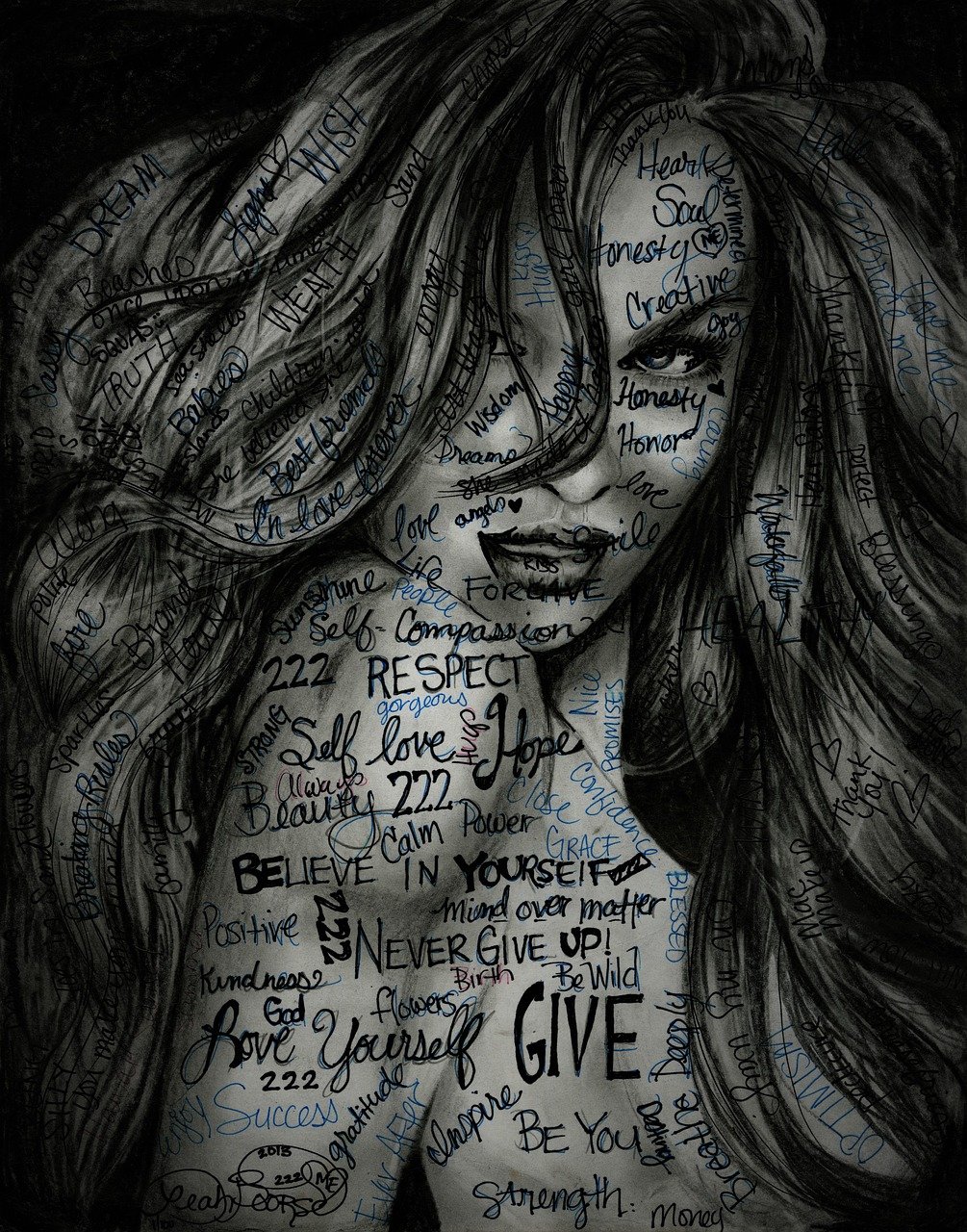
But personally, she can be really, really very hard on herself.

She’s a lot like a lot of people I know, and – if I’m totally honest – me. She doesn’t always realise it, but she carries a lot of voices in her head and baggage: unkind things that have been said to her in the past that she hasn’t completely dealt with. And it’s not until she faces a new trauma that we learn how much those past shadows still haunt her, and influence her behaviour. She’s scared, so used to being hurt and let down that she almost expects it, and therefore finds it really hard to trust people.

Fortunately, the rotten author who gave her such a dark back story (me again!) isn’t really that mean, and wrote in a hero – and a glittery little fairy princess – who are going to do their best to help Liv find some self-confidence again, to remind her how to be kind to herself – and hopefully love herself again. This leads me nicely to one of my favourite lines in this book, which I liked so much that I had it printed on a mug!

So, thank you, Jan – for reminding me that sometimes I need to take a page (or at least a quote!) out of my own book…

And to everyone else: make sure that the voices you pick to listen to, the
ones that influence your behaviour and how you feel about yourself, are kind ones. Maybe when you’re next having a bit of a wobble, or a hard time, change the message and story you are telling yourself… speak to yourself the way your friends would talk to you. Or how you would talk to them. Instead of being your own harshest critic – just for a few minutes try being your own, biggest cheerleader. Because you are awesome, you are unique and you are worth it.

You might be surprised how effective a few minutes of self-kindness can be.


And now that I’m feeling a bit less sorry for myself, I’m going to go and pull on one of my favourite happy dresses (made by Popsy, by the way – you cannot beat them for feel-good, confidence-inspiring dressing!) – maybe skip around in some flowers, and try to practice my own advice and be a little bit nicer to me for a bit.


Thank you for your interesting post, Ella. I'm sorry you've had a hard time dealing with some negative reviews. Here's one of the lovely comments and positive reviews you've had already for your new book instead:

'A fabulous feel-good read from Ella Cook that will tug your heartstrings in all directions. Really great storylines for both Dr Olivia Emery and Dr Callum Mcpearson that will cleverly draw you in to a couple of heart-stopping moments when their tentative relationship comes unstuck.'

About the author

Ella’s been obsessed with books since the moment she could reach to pull them off the shelf by herself, and has wanted to write for as long as she can remember.

She grew up in London where fairies lived at the bottom of her Grandma’s garden, and she still looks for magic – and often finds it – in everyday life.

She won the SWWJ Floella Benjamin Award in 2019, and published her debut, BEYOND GREY with Choc Lit and Ruby Fiction in 2021. Her books are now published by Joffe Books, who won the IPG Trade Publisher of the Year in 2023. She doesn't plan to stop writing any time soon.

When she emerges from her fictional worlds, she writes bids for children’s services and lives in Warwickshire (where there are probably more fairies) with her ever-loving husband who reads all her stories first and makes gallons of tea in magical cups that keep drinks warm for whole chapters.

Weblinks https://linktr.ee/ellacookwrites

Blurb

One broken-hearted city doctor. A countryside surgery in need of a new GP. The perfect love story bound to get your pulse racing . . .

Dr Liv Emery is at her wits end. Her perfect life was within her grasp. Instead she’s dealing with the fallout of being dumped by her long-term boyfriend in the cruellest way possible.

Then on top of everything else, a patient goes berserk on her. It’s the final straw, and there’s only one thing for it . . . A new start.

So she jumps at the chance to cover her former professor’s GP surgery in the Cotswolds and waves goodbye to the city. And good-for-nothing men.

Life in the village of Broclington is a far cry from London — and her cottage is a welcome change from her old shoebox flat. But her relief is short-lived after meeting her prickly boss Callum.

But perhaps he has his reasons . . . It’s not easy juggling being a single parent to a fairy-obsessed six-year-old while staving off bosses breathing down his neck about funding cuts.

The more Liv gets to know Callum and his daughter, the more she realizes she may be able to help them — and the village practice — more than she could have imagined.

But will her time in Broclington be the healing experience she so desperately needs, or could she end up heartbroken once again?

Fans of Beth Moran, Alison Sherlock, Cathy Bramley, Heidi Swain, Marie Laval or Lisa Hobman will fall head over heels for this cozy romance full of heart.

READERS ADORE ELLA COOK’S FEEL-GOOD ROMANCE:
⭐⭐⭐⭐⭐ ‘A lovely feel-good book.’ Rosamond C.

⭐⭐⭐⭐⭐ ‘Brilliant characters and a great insight into village life.’ Gill K.

⭐⭐⭐⭐ ‘A sweet story.’ Evangelia M.

Buying Links

Summer’s Christmas (Broclington Book 1 – in case you missed it) 

 https://www.amazon.co.uk/gp/product/B0CBKN1ZTJ/ref=dbs_a_def_rwt_hsch_vapi_tkin_p1_i0

Healing Hearts in the Little Village (Broclington Book 2 – don’t worry, it reads well as a standalone novel, although obviously I’d recommend starting with Summer!)

https://www.amazon.co.uk/gp/product/B0CBKN1ZTJ/ref=dbs_a_def_rwt_hsch_vapi_tkin_p1_i0

Thank you for reading. Writers, how do you deal with things when your confidence in your writing takes a knock?

You may also follow me on Twitter @JanBaynham, on my Jan Baynham Writer Facebook page and on Instagram janbaynham.

To find out more about me and my books, please visit my AMAZON PAGE. Thanks.

Monday, 19 June 2023

 Guest Post with Luisa A. Jones

This week, I'm very pleased to welcome the talented author, Luisa A. Jones, to the blog for the first time. Her first historical novel, The Gilded Cage, will be published by Storm Publishing on Thursday 22nd June.

Welcome, Luisa. I'm always fascinated by the research an author does when writing historical fiction so I can't wait to find out about some of the research you undertook for your new novel. It's over to you!

Thank you, Jan, for inviting me to share some insights into how I researched my historical fiction for The Gilded Cage. I’ve read and loved all your books, so I feel honoured to be asked to contribute to your blog.

Central to my protagonist’s story in The Gilded Cage was her decision to learn to drive, and the confidence she gained from attaining this skill. I set the story just before the First World War, not only because I find it a fascinating era with its rapid technological and social changes, but also because it was a time when it was still fairly unusual for a woman to become a motorist.

My research revealed that, from the earliest days of motoring, there were female drivers who were just as excited as men by the speed and independence afforded by motor cars. The Ladies’ Automobile Club was founded as far back as 1903. As motoring was so expensive, it was an option only open to a privileged few, so around half of the Club’s founding members were titled ladies. The annual subscription fee of two guineas provided technical advice and information, driving instruction for ladies and their servants, organised motoring tours, competitions, garaging to rent, and a social space to meet at the luxurious Claridge’s hotel in Mayfair. Lectures were held on topics such as “Motors and Morals”. As time went by, the club expanded into charitable work, providing funds for a hospital bed for those injured in road traffic accidents, and setting up a motorised field kitchen during the First World War.

I loved learning about some of the famous women drivers of the day. These included Dorothy Levitt, whose snappily titled book The Woman and the Car: A Chatty Little Handbook for Women Who Want to Motor provided me with much inspiration (and a fair bit of incidental detail) for Rosamund’s experience of driving and car maintenance.  Levitt was a Jewish Londoner whose talent for motoring and boating led her to set land and water speed records for women and made her a well-known celebrity. She took part in (and often won) many speed trials, and loved to drive with her Pomeranian dog, Dodo, on her lap. She was something of an innovator: it was Levitt whose suggestion of carrying a hand mirror to see the road behind led to the development of the rear-view mirror.

Please click on the link for a photograph of Dorothy behind the wheel -https://www.flickr.com/photos/carlylehold/48025764841/in/

Other notable female motorists included Aileen Preston, who had a motoring school in London and called herself “the first woman to take up motoring as a career”; and Muriel Thompson, a talented racing driver who won the first Ladies’ race at Brooklands in 1908 and went on to become a volunteer ambulance driver in the First World War, winning the Military Medal and the Croix de Guerre for her brave service. The lesbian actress Vera “Jack” Holme was noted as Britain’s first female chauffeur in 1911: a committed suffragette, she was Mrs Pankhurst’s chauffeuse-cum-getaway driver. It struck me as I was writing that such role models could be an inspiration to my protagonist.

Please click on the link for a wonderful photograph of 'Jack' in her role as chauffeuse to Mrs Pankhurst - https://www.flickr.com/photos/lselibrary/22143984233/

In the Edwardian period there were several British manufacturers of motor cars: the most famous of them, Rolls Royce, is of course still in existence, although it is now owned by the German company BMW. I decided to celebrate one of the less well-known marques, and settled on a Wolseley limousine-landaulette as a suitably luxurious and powerful model to be owned by a wealthy industrialist at that time. Only twelve of these are known to still exist today, dispersed around the world. According to the 1913 Wolseley catalogue the specific model I wrote about cost £800; optional extras such as a spare wheel, silk blinds, leather upholstery and a number plate would have increased the cost. For comparison, a lady’s maid at that time might expect to earn around £32 per year.

Please click on the link to see a photograph of the Wolseley 24/30 Limousine-Landaulette - 
https://www.maryevans.com/history/wolseley-24-30-hp-limousine-landaulette-10215539

I was very fortunate in being able to confirm some specific details with a member of the Wolseley Register veteran car club, having found the group on the internet and contacted them via email. He kindly sent me videos, articles and photographs as well as taking the time to answer my questions about such topics as the top speed of a Wolseley 24/30 Limousine-Landaulette and whether the driver’s side front door actually opened (it didn’t, which led to quite a few edits!).

For so many of us even today, whatever our gender, the skill of driving opens up a world of independence that can be truly life changing. While many women drive and own cars nowadays, I can’t help thinking it’s a shame that so few are well-known in the fields of motoring journalism or motor sport. All the more reason, perhaps, to celebrate the achievements of those bold “motoristes” of yesteryear.

Thank you, Luisa. That's so interesting. Women living at the time in which you've set your novel had such a different life to one they would have had today. The motor-car and being able to drive is something we all take for granted. 

The Gilded Cage https://geni.us/98-Storm

About the book:

1897. Rosamund bows her head and steps slowly down the aisle. The satin of her gown whispers against the stone floor and a single tear falls into the bunch of yellow roses twisted in her trembling hands. Despite rumours of his cruelty, Rosamund has no choice but to become this man's second wife.

After her wedding, Rosamund finds herself trapped in Sir Lucien'Fitznorton's lonely country estate. As she wanders the chilly halls, made shadowy by drapes of heavy velvet, she longs for the lost comforts of her childhood home, where she was the beloved only daughter to a doting father, now buried miles away. As a young woman with no fortune of her own, only death can release her from this misery.

Until she meets Joseph, her husband's gruffly handsome new chauffeur. With his mop of salt-and-pepper hair and lilting accent, Joseph is from another world. One of clambering children and tea at scrubbed kitchen tables, the hollow scratch of hunger and long hours of hard work. Despite their differences, they find themselves increasingly drawn to one another.

But Sir Lucien is not only cruel, he's devious too, and soon Rosamund finds herself caught in a dangerous web of secrets and lies. Is Rosamund's fragile marriage nothing but a golden cage, trapping her between two men who desire her... and to what end?

One holds her captive and the other offers her a hope of escape... but who really holds the key to Rosamund's gilded prison?

SOCIAL MEDIA LINKS 

Twitter: @TaffyLulu

Facebook: https://www.facebook.com/LuisaAJonesauthor/

Website: www.luisaajones.com

Thank you for reading. I'm sure you found Luisa's post as interesting as I did. If you write historical fiction, what have you researched that is commonplace nowadays? I'd love it if you left a comment. Thank you.

You may follow me on Twitter @JanBaynham and on my Jan Baynham Writer Facebook page. 

I have just started an Instagram page, janbaynham.

For more about me and my writing, please click on my AMAZON  page.


Monday, 12 June 2023

 Guest Post with Jill Barry

This week I'm delighted to welcome my very good author friend, Jill Barry (aka.Sandra Mackness) back to the blog. Her new book, Love at War, will be published by ROMAUNCE BOOKS on Wednesday 14th June.

Sandra, welcome back. I know this new book means a lot to you so why don't you tell the readers more about you and your new novel, please? Over to you!

Thanks, Jan. It's a pleasure to be back. So, who am I?

I can’t recall a time when I didn’t love books, but never imagined writing them. I wanted to be a chorus girl. Or an air hostess. I did achieve the latter! Much later, my writing career began with short stories for anthologies and women’s magazines. Several of these stories have won prizes, but my true love is the novel.

My tender romances are published by D C Thomson Pocket Novels; these are also available from public libraries as large print Linford Romances. Other contemporary and historical romances are published by Lume, now part of Joffe Books. My only psychological suspense is published by Headline Accent.

I love learning more about my craft and since the year 2001, have attended residential courses, run by Literature Wales, also conferences organised by the Romantic Novelists’ Association and the Historical Novel Society. Gaining my MA in Creative Writing gave me the confidence and street cred to run writing workshops for adults, also to tutor students attending InterHigh, an online school with pupils worldwide. I continue to mentor aspiring authors, also to read for the Romantic Novelists’ Association’s popular New Writers’ Scheme, something I feel hugely privileged to be involved with.

In 2004 I moved to Carmarthenshire and discovered Liz Fielding lived not far away. I began attending the chapter meetings she ran, until Liz moved house and I somehow parachuted into meetings which a group of local writers were holding in Cardiff. I enjoyed organising chapter meetings and since then, the Cariad Chapter membership has snowballed. The current organisers arrange Zoom sessions and workshops, also real-life meetings where we discuss all sorts of writing matters. And eat cake! We’re also supportive of one another on social media.

Throughout my writing career, I have built relationships with local newspapers and radio stations, also public libraries. BBC Radio Wiltshire, Radio Berkshire, Radio Wales, Chris Evans, formerly of BBC Radio Two, and Showboat TV, an online streaming service, have all interviewed me.


My research for Love At War has been fun and, thanks to Facebook specialist groups, has brought me back into contact with old classmates and a couple of forgotten relatives. My questions have stirred up interest in Love At War which is my ‘Book of the Heart.’ 


Whitmore Bay, Barry

The novel is a World War Two romance mainly set in my hometown of Barry in South Wales, and also in Bari, Italy


Campell's Steamer

I also hope to continue my enjoyable relationship with The People’s Friend and My Weekly. I love entertaining my readers and have worked happily with various editors.

My varied career has influenced my plot lines and my characters. Former roles include Secretary/Butlin Redcoat, airline receptionist, hotel receptionist and flight attendant. I have also been employed as Secretary/PA in industry and run a village guest house with my husband. The old Victorian School we converted was haunted, but the little ghost was friendly and provided inspiration!

There are still books I want to write, and I’m delighted to have a TBW list as well as the TBR pile. Being an author often involves a bumpy ride, but I’m still enjoying my journey.

Thank you, Jill. I am always in awe about how many novels you have written. I love the idea of having a 'To Be Written' list as well as a 'To Be Read' list. Having had the privilege to read an early draft of Love at War, I know readers are in for a treat when they read your latest story.

ABOUT THE NOVEL: 

Love at War begins halfway through World War Two when Anna Christensen has almost completed her business training. The daughter of a handsome Norwegian seafarer and his beautiful wife, Anna's looks attract much attention and it is this that drives the story of two men and one woman. Charismatic Captain Charles Milburn and his aide, 2nd Lieutenant Geoffrey Chandler, are both attracted to the depot's new shorthand-typist, but it is Charles, although engaged to be married, who finds Anna irresistible.

SOCIAL MEDIA LINKS:

Facebook:    https://www.facebook.com/JillBarryBooks

Twitter:       https://twitter.com/barry_jill

Website:       https://www.jillbarry.com

Amazon Page:  https://www.amazon.co.uk/Jill-Barry/e/B00FE0GQJ0

BUYING LINKS:

Love at War is available from Romaunce and Amazon in paperback and as an ebook:

tinyurl.com/RomaunceLoveAtWar

Thank you for reading. Writers, do any of your career choices influence your plot lines or characters? Do you have a TBW list like Jill? I'd love to read your comments below. Thank you.

You may also follow me on Twitter @JanBaynham and on my Jan Baynham Writer Facebook page.

For more about me and my novels, please visit my AMAZON page.


Tuesday, 23 May 2023

 #HistFicMay - What's that about?

I came across the hashtag, #HistFicMay, by accident and I'm so pleased I did. Scottish writer, Virginia Crow decided to run a social media event on Twitter throughout May, giving an opportunity for historical fiction authors to spread the word about their writing.

Every day writers are invited to answer questions and accept challenges with posts, pictures and/or quotes, using the hashtag #HistFicMay. The first week was about introductions; the second was about research; the third was about sub-genres; the fourth is now about characters and in Virginia's words, 'the last few are random!' We could take part as often or as infrequently as we wanted to.  

I took the opportunity to answer questions and prompts about my new novel, with its working title of
A Tale of Two Sisters. Having now completed my first set of edits, I found taking part proved to be an excellent way of reflecting on what this fourth novel is about. The novel is set in rural Wales and Sicily in 1943 and 1968. It involves a family secret, forbidden love and ultimately forgiveness, where two sisters work together to clear their father's name of a crime he did not commit.
My main character is Claudia Rosso. She is an artist who travels to Sicily from her native Wales to find out why her father, Carlo, a former Italian POW interned in a prison camp in mid-Wales could never return to his homeland when WW2 ended. 
When identifying a sub-genre in my novel on Day 15, I found this perhaps the most useful and I can see it will help when having to tell people about my writing. Yes, all my novels are set in different historical eras, but there are not necessarily about the historical events themselves. They are family stories about ordinary people living at certain times in history, having to deal with what that era demands of them. Therefore, I do not write historical fiction 'per se'.The sub-genre I identified was 'historical romance'. There is a love interest in all my books and in A Tale of Two Sisters, there is a love story in both the 1940s story and the 1968 one. Claudia is taken on her first boat trip by Alessandro and they visit a heart-shaped cave. They are just friends but could he have something more romantic in mind? On Day 17, the quote I chose to illustrate my sub-genre was from further on in the story.

'It was turning into a perfect evening. There was something quite sensual about being with someone who took your hand and kissed you gently, looking at someone with longing but knowing they weren't ready to love you back. Yet. That word was important.' 
Courtesy of G. Lancett
The biggest pitfall for my sub-genre of historical romance was early on in the novel when I had to allow my characters to fall in love yet stay within the rules imposed on the POWs regarding fraternisation with local women. Even after Italy capitulated in 1943, that rule remained and if it was broken, the POW would be confined to the prison camp. Did I succeed?

As well as thinking about my own novel, it's been so good to read the posts from others taking part. The benefit of Virginia's idea is that I've found lots of new historical novelists to follow. Many of their books sound wonderful and are finding their way onto my ever-growing TBR pile. When May is over, I shall continue to keep in touch by taking part in #HistFicThursdays. So a big thank you to Virginia! 

Thank you for reading. Do you have a sub-genre in your writing? If so, I'd love you to comment and tell us all what it is. 

Hopefully, next time I shall have more news about the new novel with a confirmed title, a cover and a publication date from my new publisher, Joffe Books/ Choc Lit Publishers . Watch this space! 

You may follow me on Twitter @JanBaynham and on my Jan Baynham Writer Facebook page.
For more about me and my books, please visit my AMAZON page where all the novels are 0.00p on Kindle Unlimited at the moment if you are a subscriber.

Monday, 24 April 2023

 Guest Post With Sally Jenkins

Today I'm very pleased to welcome fellow Joffe Books /Ruby Fiction author, Sally Jenkins, to the blog. Her debut novel, Little Museum of Hope, is due to be published tomorrow, Tuesday 25th April.

Sally, welcome. I'm really looking forward to what you have to tell us about your new novel. It's over to you.

Little Museum of Hope 

When I give talks about my writing or mention it to friends and family, one question pops up again and again: Is it autobiographical - did this happen to you? My answer has always been an emphatic No, and I believed that to be true.

However, on reflection, I’ve been lying.

In Little Museum of Hope, several characters share chunks of their life stories with the creator of the museum, Vanessa. None of these stories mirrors my own life but several of them draw directly on tiny parts of my own experience. When I listed these, I was shocked at how much of my life is in the novel:

·       Within the museum is the Mended Heart Café, also run by Vanessa, even though she is a disaster at baking - like me! My cookery teacher wrote on my school report: Sally’s written work is far better than her practical work. Vanessa received the same diplomatic criticism.

·       Maxine is one of the first donors to the museum. She shares the story of her teenage love affair with the boy next door and its dark repercussions into her future. I never got as far as the love affair but I did have a crush on our neighbour’s son and, like Maxine, watched for him out of the window.

·      

 Stephen tells Vanessa how he learned to bell ring, in order to cope with grief, and reveals that it created new problems in his life. He donates ‘Diagrams’, a bell-ringing book, to the museum. I have been a church bell ringer since the age of fourteen and I own a copy of that book – albeit without the loving inscription found inside Stephen’s copy. My own experience in bell towers was invaluable to accurately describe Stephen’s first trip up a spiral staircase and into the ringing chamber.

·       Rose has a very minor role in Little Museum of Hope but, like me, she discovers the benefit of a Speakers’ Club. Some years ago, when I began to write seriously, I joined a Speakers’ Club because I knew I needed to grow my confidence in order to promote myself and my books. It was one of the best decisions I ever made!

·       I’m probably not the only 1960s (and possibly later?) baby to have had to learn to walk by pushing a cute stuffed dog on a frame. My Ruby Fiction editor put her hand up to this as well! When Joanne brings her old family album to the museum it features a picture of her, as a toddler, in the garden with a dog just like my own.

·       I work part-time in IT and, in the past, I’ve struggled to make my job interesting enough to use in fiction. In Little Museum of Hope, Karen has an office affair and her employer is an IT company – finally giving me the opportunity to drop in a few tiny details to add realism (not about the affair!).

Back to that original question: Is it autobiographical - did this happen to you?

New answer: None of the things in Little Museum of Hope happened to me in their entirety but there’s a little bit of me in many parts of the book. Plus, there may be more than I’m owning up to here!

About Little Museum of Hope

A jar of festival mud, a photo album of family memories, a child’s teddy bear, a book of bell ringing methods, an old cassette tape, a pair of slippers …

These are the items that fill the exhibit shelves in Vanessa Jones’ museum. At first glance, they appear to have nothing in common, but that’s before you find out the stories behind them …

Because Vanessa’s Little Museum of Hope is no ordinary museum – its aim is to help people heal by donating items associated with shattered lives and failed relationships, and in doing so, find a way to move on, perhaps even start again.

The museum soon becomes a sanctuary for the broken hearts in Vanessa’s city, and she’s always on hand to offer a cup of tea, a slice of cake and a listening ear.

But could the bringer of Hope need a little help moving on herself?

Buying Links

Amazon:  https://www.amazon.co.uk/Little-Museum-Hope-Guaranteed-heartstrings-ebook/dp/B0BW4SZXRQ/

Sally's AMAZON page

About the Author

Sally Jenkins lives in the West Midlands with her husband. When not writing and not working in IT, she feeds her addiction to words by working part-time in her local library, running two reading groups and giving talks about her writing. Sally can also be found walking, church bell ringing and enjoying shavasana in her yoga class.

Get in touch or follow Sally:

Website/blog: https://sally-jenkins.com/

Facebook: SallyJenkinsAuthor

Twitter: @sallyjenkinsuk

Instagram: @sallyjenkinsuk

Thank you, Sally. That was fascinating. I'm sure readers will now be guessing about which other autobiographical snippets you didn't own up to! I hope the novel does really well and your sales soar. 

Thank you for reading. I hope you enjoyed reading Sally's post. As readers, do you wonder how much of a novel may be autobiographical? As writers, Do you include events and experiences from your own life in your novels? I'd love it if you commented below. Thank you.

You may also follow me on Twitter: @JanBaynham and on my Jan Baynham Writer Facebook page. 

For more about me and my novels, please visit my AMAZON page.


Monday, 17 April 2023

Guest Post With Kirsty Ferry

Today, I'm delighted to welcome writer, Kirsty Ferry, back to the blog. We are both authors with Choc Lit and Ruby Fiction, which are now part of a much larger publisher, Joffe Books. Her new novel, Bea's Magical Summer Garden, is to be published tomorrow, the 18th of April. 

Welcome back, Kirsty. First of all, congratulations on the publication of another novel in the Schubert series. I'm dying to know if this story is going to be the last in the series and if so, how you feel about that. Over to you!

I can’t believe this is the sixth Schubert the Cat book! When I started a few years ago with Every Witch Way, I didn’t think for one moment I’d end up writing six novellas about this magical, mystical black cat. Bea’s Magical Summer Garden wasn’t meant to have Schubert in, but as any author will tell you, when we hit that creative block we just have to set the work aside for a little and see what happens. In this case, Schubert was pretty insistent about being in the book, so I had to give in and let him appear, and the book came much, much more easily after that.

I’d run out of McCreadie siblings by the time I started Bea, although from the moment Bea appeared as a minor character in It Started with a Wedding, angrily hacking back her overhanging plants at the behest of The Man in the Big House, I knew she was going to be the focus of the next book I wrote. It was just a case of finding a story that fit with her, and going from there.

During lockdown, I had a lot more daytime TV on, and I watched programmes such as Homes Under the Hammer and Escape to the Country. I will often put them on ‘for the dog’ when I’m in the house during the day now; but as he sleeps most of the day, I am the one that has the guilty pleasure of peering into other people’s homes and seeing the transformation of the auctioned properties in Homes Under the Hammer. I must, however, confess to yelling at the TV when I feel people have just gone on and wasted the Escape team's time, and I do occasionally mutter obscenities at the smug people who buy an auctioned home to ‘add to their portfolio of multiple rental properties.’  But it’s like poking your tongue into a poorly tooth; it’s enjoyable in a weird way! And it certainly inspired this book.

I have always loved old houses, and houses with secrets, and although Glentavish House – the Big House in the book – doesn’t really have any secrets, I liked the idea of someone buying a slightly run-down place and loving it again. A sort of Hammer in the Country mis-mash, I guess! An unfinished folly was also a lovely thing to imagine; it sort of brought the two halves of the story together, and it fitted with the tragic life of Lady Clementine whose husband hadn’t managed to build her the place she wanted whilst she lived one hundred and fifty years ago. I did have a slight danger of dwelling too much on Lady Clemmie’s potential ghost running around Glentavish in Bea, and had to rein her in. Both Bea and Marcus, the other main character,  are a little too down-to-earth to accommodate ghosts in their day-to-day lives, so the odd time where Clemmie makes herself known should hopefully have a bit of a ‘less is more’ feel. I do love writing my ghost stories, and may pick my timeslips up at a later date; but for now I am enjoying writing more contemporary, humorous books.

And will there be a seventh Schubert book? At this present moment in time, I just don’t know. My wonderful little publisher has now become part of a wonderful big publisher, and whether I can indulge my own follies with writing more Schubert books is for the future. But in the meantime, I do hope you enjoy Bea’s Magical Summer Garden, and enjoy Schubert’s latest foray into his wonderful, magical world!

About the book

What’s not to love about Bea’s Garden?

Its higgledy-piggledy layout, fascinating plants and occasional resident black cat makes it the most charming place to visit on a sunny afternoon. Plus Bea has bees – and her Honey Festival is sure to create a buzz.

But not everyone thinks Bea’s Garden is the bee’s knees.

The Man at the Big House next door has been a thorn in Bea’s side for the longest time, with his unnecessarily snippy letters about her beautiful climbing plants ruining his ‘clean lines’. Could he and his poisonous project manager Carla pose problems for her Festival? Or can Bea rely on the Man’s cousin – and her newest annual pass holder – Marcus Rainton to fight her corner?

With bee best friends, big black cats, a secret garden gate and a surprising identity reveal, Bea’s Garden is surely in line for its most magical summer yet!

Bio
Kirsty Ferry is from the North East of England and lives there with her husband and son. She won the English Heritage/Belsay Hall National Creative Writing Competition in 2009 and has had articles and short stories published in various magazines. Her work also appears in several anthologies, incorporating such diverse themes as vampires, crime, angels, and more. 
Kirsty loves writing ghostly mysteries and interweaving fact and fiction. The research is almost as much fun as writing the book itself, and if she can add a wonderful setting and a do9llop of history, that's even better.
Her day job involves sharing a building with an eclectic collection of ghosts, which can often prove rather interesting.

For more information about Kirsty, visit:


Buying links:


Thank you, Kirsty. That was so interesting. Your enthusiasm for writing ghost stories is clear. I love the fact that you can choose between your timeslips and your contemporary, humorous stories. Good luck with the sales of your new novel.

Thank you for reading. I hope you like the sound of Kirsty's latest novel as much as I do. 
You may also follow me on Twitter @JanBaynham and on my Jan Baynham Writer page on Facebook. For more about me and my books, please visit MY AMAZON PAGE.