Saturday, 15 October 2022

 Fact Finding Again

When is the best time to undertake research for your novel? Before you start writing the first draft? Making references to what information is needed as you go along and do the fact-finding afterwards? Having three published novels under my belt now and motoring through novel four, I've come to some conclusions. They are all set in the past and I have increased the research with each one.
The research for Her Mother's Secret, set in 1969, tended to be done as I went along and following up on notes I'd added in the margins - check this, find out about this. The sense of place on which many people have commented was created from having visited the country and a number of islands many times. Having followed an art course in college, I was able to draw on personal experience for Elin's paintings and the exhibition Getting the names right for a certain time is important to me so I researched what were popular Christian names in Wales and Greece for the age of my characters. I remember checking whether Alpha or Mythos beer would be served in a taverna in 1969! Did it really matter some would say? To me, it did. I also researched the effects of LSD for the drug-related part of the plot, world events and pop music at the time to try to add authenticity to the story.

When it came to novel two, Her Sister's Secret, I moved further back in time to 1946 and 1966. This time I needed to do some research before starting to write. The novel starts when WW2 had ended but rationing was still in place and the Black market was rife. I researched what punishments were meted out to spivs who were caught dealing as it was important for one of my characters to be 'away' for a certain length of time. I found out about Prisoners of War working on local farms, their uniforms and typical Italian names of the time. During writing the first draft, I then found out facts that were needed as I went along or made a note to come back and expand this or that point. Google maps were invaluable when setting the Sicily part of the novel. I'd hoped to visit the island but COVID struck and research was only online.

Her Nanny's Secret, my third novel, was set earlier again, in 1941. As I planned the novel, I researched the dates of the German advancement into Northern France, the French resistance movement and the POW Italian chapels built on the prison camps before writing the first draft. I thought it was important to do that before plotting out the story. Other topics I researched during the actual writing process included the everyday routines of a stable girl, wills and inheritance, especially how it differs in France, and the permanence or otherwise of memory loss. The second part of the novel is set in 1963. I found it interesting to revisit an area of France I know well. Again, as in the previous two novels, I researched Christian names to be authentic for the time and social class of the characters in Wales and France as well as common surnames in both countries.

For my WiP, novel four, I have undertaken the most research so far. Again, set in WW2, events in the war needed to be accurate but this time with the addition of the Allied invasion of Sicily. My novel, as always, deals with personal stories of the war rather than the military one but underpinning those, there has to be accuracy even though much of the research will not appear in the novel. My last three blog posts tell of the visit I made to the POW Camp, Hut 9 and my trip to Sicily. The visits have proved invaluable since I now have a wealth of notes and photographs to draw on. On my return, I've also visited Henllan Bridge Prisoner of War Camp 70 in West Wales. The camp was home to 1,200 Italians during the war. The POWs had no place to worship and gave up one of their huts, converting it into a Catholic Chapel. Although I'd read about it, nothing prepared me for the beauty and feel of the chapel and seeing the ingenuity of the POWS by making such a special place from found and scrap materials. I came away with ideas about the role Carlo played in creating a similar chapel for his fellow prisoners in my novel. 


I'm enjoying fully immersing myself in the stories of Sara, Carlo and Claudia. The research I've done is helping me to write without interruption. 

Thank you for reading. How do you approach research for your novels? I'd love it if you left a comment. Thanks.

***** Look out for some guest posts about undertaking research from other authors over the next few weeks.*****

You may also follow me on Twitter @JanBaynham and on my Jan Baynham Writer Facebook page.

Please click on MY AMAZON PAGE for more about me and my books. Thank you. 

Thursday, 1 September 2022

 Research Trip to Sicily - Part 2

Day 3 - In novel four, Carlo's mother. Lucia, worked as a servant for a wealthy influential family. Sometimes she took him to their villa with her when he was a little boy. The magnificent building where the family lived was in stark contrast to the modest house where the Rosso family resided in a run-down neighbourhood of the same town. Having read Daphne Phelps's book about 'Casa Cuseni' in Taormina on the recommendation of Sarah Kearney on her White Almond Sicily Blog, I knew I wanted to visit the house and wondered if it would provide inspiration for the villa in my novel. Jo and I caught the 8.30am bus to Taormina, enjoying views of the vegetation and fruit trees as we travelled along the coastal road.The magnificent spectacle of Mount Etna was ever present. In contrast to Siracusa and Ortigia, Taormina is perched high above the Ionian sea with amazing views. 

Our tour was booked for11 am and climbing the streets from the bus station to the villa in blistering heat was a feat in itself. Once there, we sat in the shade waiting for Maria, our guide, to start and admired the stunning views. The house was built in 1905 by the British painter, Robert Kitson. The project was overseen by Sir Alfred East and Sir Frank Brangwyn. Kitson left the house to his niece Daphne Phelps in 1947. Many famous people stayed at Casa Cuseni - Pablo Picasso, Bertrand Russell, Greta Garbo, Coco Chanel, Roald Dahl - to name but a few. We were shown a number of first-edition books and original paintings 

The front of the villa.
View from Casa Cuseni
Greta Garbo's sofa -
she lived there for over
 a year in 1950
My gift from
Signor Spadaro
One of the highlights of the tour for me was standing in the dining room
, the creation of Sir Frank Brangwyn. When I told Maria that I was distantly related to him - my great-great-grandfather and his father were cousins - she was delighted. The wonderful frescoes on the walls remain intact in spite of two world wars and tell the love story of the owner, Robert Kitson, and his partner, Carlo Siligato, who, when Messina was destroyed in an earthquake in 1908, together adopted a child, Francesco. It was a forbidden relationship at the time and had to be kept secret. Sir Frank designed the panelled walls, the high-backed chairs, and the round table in Art Nouveau style. When Maria told the present owner, Francesco Spadaro, about my link to Sir Frank Brangwyn, he insisted that I should have a copy of the book he, himself, had written about the dining room. It's a large, beautifully produced book with fabulous illustrations and I shall treasure it. 

Next, we went outside into the garden. In one area, I love the theme of Fire and Water where the design was made out of pieces of black lava and small white pebbles and, stones from the volcano and from the sea.
Ceramic pots will
definitely appear in novel 4
Colourful shop windows
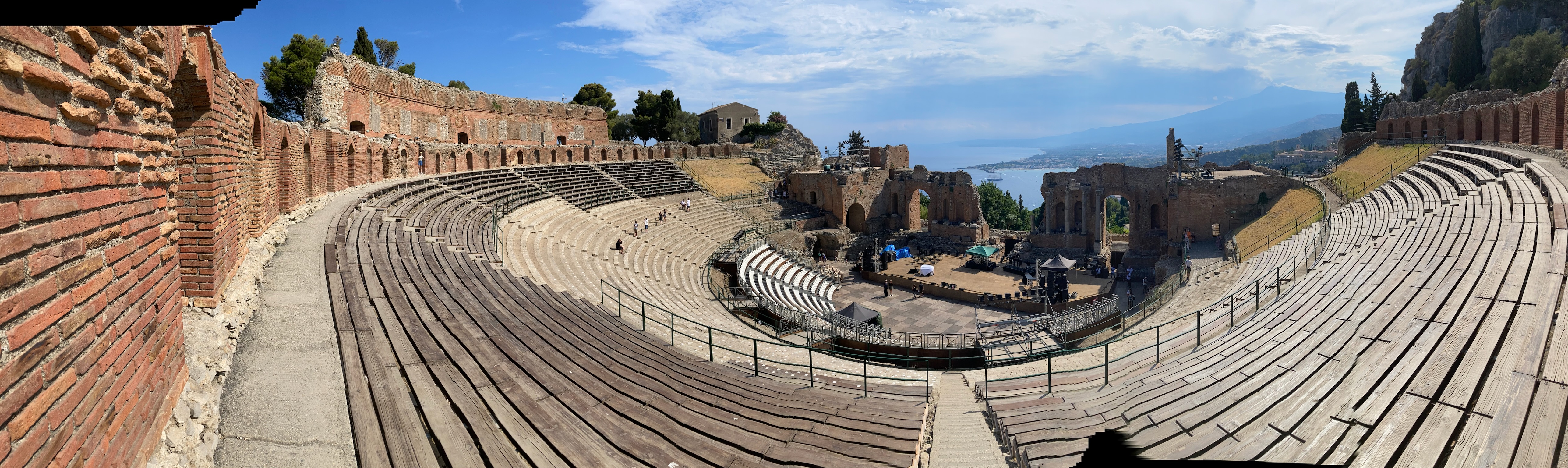
Leaving Casa Cuseni, the walk into Taormina was much easier and we rewarded ourselves with a delicious lunch in the piazza. The afternoon was spent wandering the pretty streets, visiting the Duomo, and finally the famous amphitheatre before catching the bus back to Catania. 

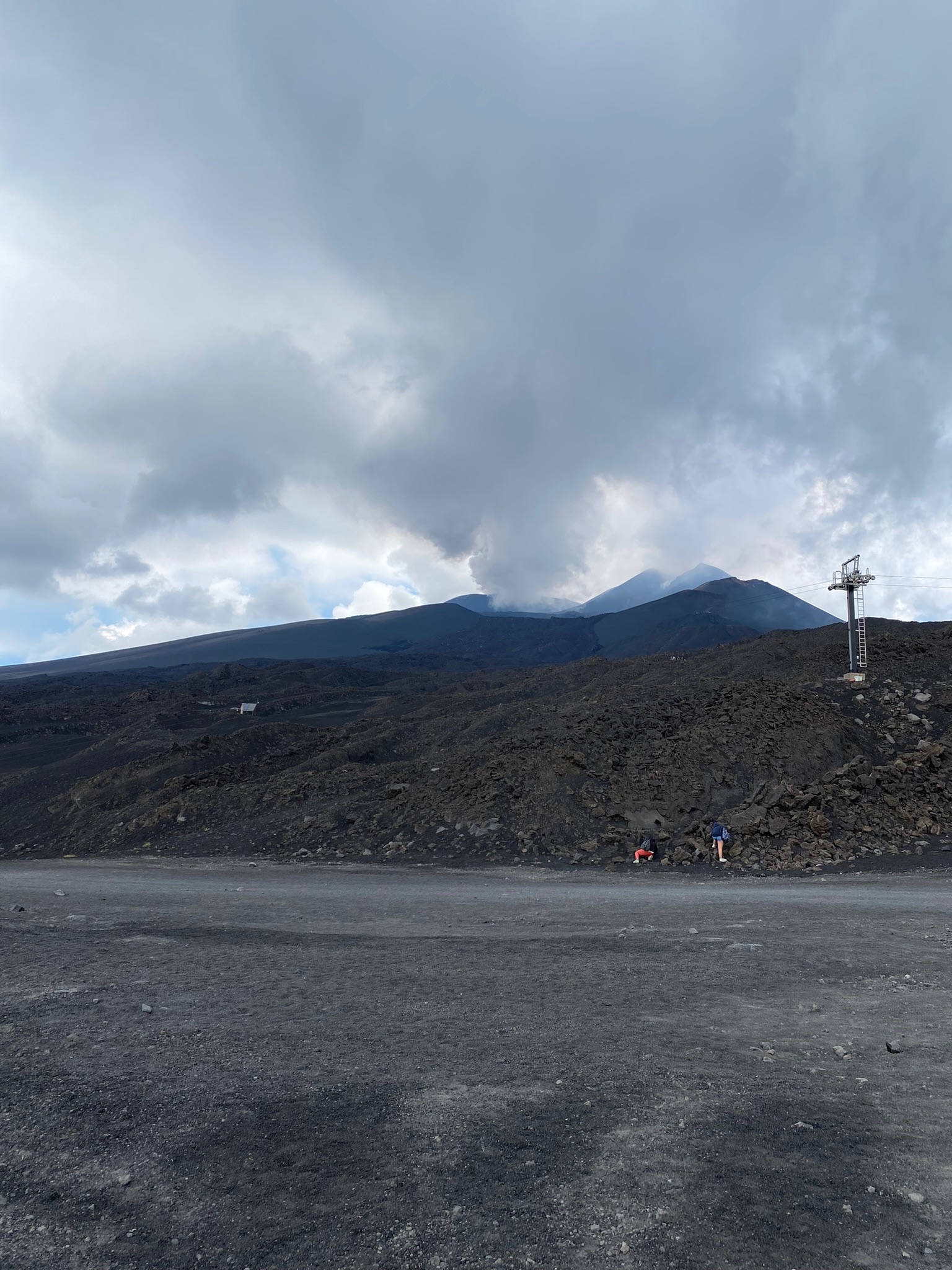
Day 4 - Our last day! Our pick-up for the airport was not until late that evening so we decided that we couldn't come to Sicily without a trip to Mount Etna. We took a bus tour and after walking nearly ten kilometres each day, enjoyed being picked up by our hotel and taken straight to our destination with its change in temperature and landscape. Seeing a house submerged and preserved in lava on the way up to the top was a stark reminder of the devastation that can be caused when a volcano erupts. I braved the cable car and the views from the top were amazing.
Submerged house
The five days flew by. After spending the day we arrived sorting ourselves out and getting our bearings, on each of the other four days we concentrated on Catania, Siracuse and Ortigia, Taormina, and finally, Mount Etna, respectively. In such a short time, we have obviously only touched the surface of what this wonderful area of Sicily has to offer. I'd love to return for a holiday but at least, I now feel I have walked in some of the footsteps of the characters you'll hopefully meet in novel four.

A huge thanks to my daughter, Jo, without whom I'd still be trying to find my way around Catania - my travel guide, research assistant, travel arranger, geological adviser, and more... Above all, it was so good to spend mother and daughter time together enjoying the evening meals al fresco and especially the cannoli and the gelatos!
.
I hope you have enjoyed reading about what Jo and I did on Days 3 and 4 in this post. If novel four is accepted and published in 2023 as I so hope it will be, I'd love it if you read it and could recognise some of the places where I walked in Carlo and Claudia's footsteps. In the novel, it will be Claudia's first visit to Sicily as it was mine. 

What book have you read lately where you could tell the author had walked in the characters' footsteps? I'd love to know. Thank you.

You may also follow me on Twitter @JanBaynham and on my Jan Baynham Writer Facebook page. 
To find out more about me and my books, please visit MY AMAZON PAGE. Thank you.

***** STOP PRESS:
'Her Nanny's Secret' will be published in paperback on Tuesday 6th September. Next week! It's available to order from all good bookshops and on-line stores. 


Wednesday, 6 July 2022

Hut 9, POW Camp

On Saturday June 25th, I visited one of the open days at Island Farm, a former German POW Camp, situated near Bridgend. It was the scene of the biggest break out of German POWs in Britain in WW2. Hut 9 is now the only hut standing and has been preserved. Although Carlo, the character in my novel is an Italian POW, it was still good to see the inside of the hut with artefacts and fashions from the time. 

The afternoon started with an excellent talk about the camp and details of the escape itself. Seventy prisoners escaped along a thirty foot tunnel from Hut 9 and breached the perimeter fence. It was an ingeniously planned affair and some got away as far as Birmingham and Southhampton. Eventually, the escapees were all recaptured and moved onto another camp. Island Farm Camp then received senior high ranking German Officers awaiting trial at Nuremberg. They included a number of Hitler's closest advisers. 

Wandering from room to room, it was good to imagine the life of the POWs in the camp. Here are a few of my many photos that I think capture the conditions of the time.


The Hut 9 Preservation Group is a registered charity, made up of volunteers who are passionate about preserving the last remaining building of Island Farm camp. Regular open weekends allow visitors to see photographs, documents and day-to-day objects as well as volunteer re-enactors who bring life at the camp to life. For more information, please visit www.islandfarm.wales, an wonderful website run by Brett Exton who gave the introductory talk.

Thank you for reading. Where have you visited as part of your research that proved useful for you to set the scene in time and place in your novel? I'd love it if you left a comment, Thanks. 

You may also follow me on Twitter @JanBaynham and on my Jan Baynham Writer Facebook page.

For more about me and my books, please visit my Jan Baynham AMAZON Page.


Monday, 20 June 2022

 Guest Post with Chris Penhall

This week I'm delighted to welcome fellow Ruby Fiction author, Chris Penhall to the blog. Her new novel, the third in her Portuguese Paradise Book series, is to be published next week. 

Chris, welcome. I'm looking forward to finding out more about The House on The Hill: A Summer in The Algarve and how it fits into your series.

 Hi Jan. Thanks for inviting me onto your blog to talk about the challenges of writing books connected to one another in a series. 

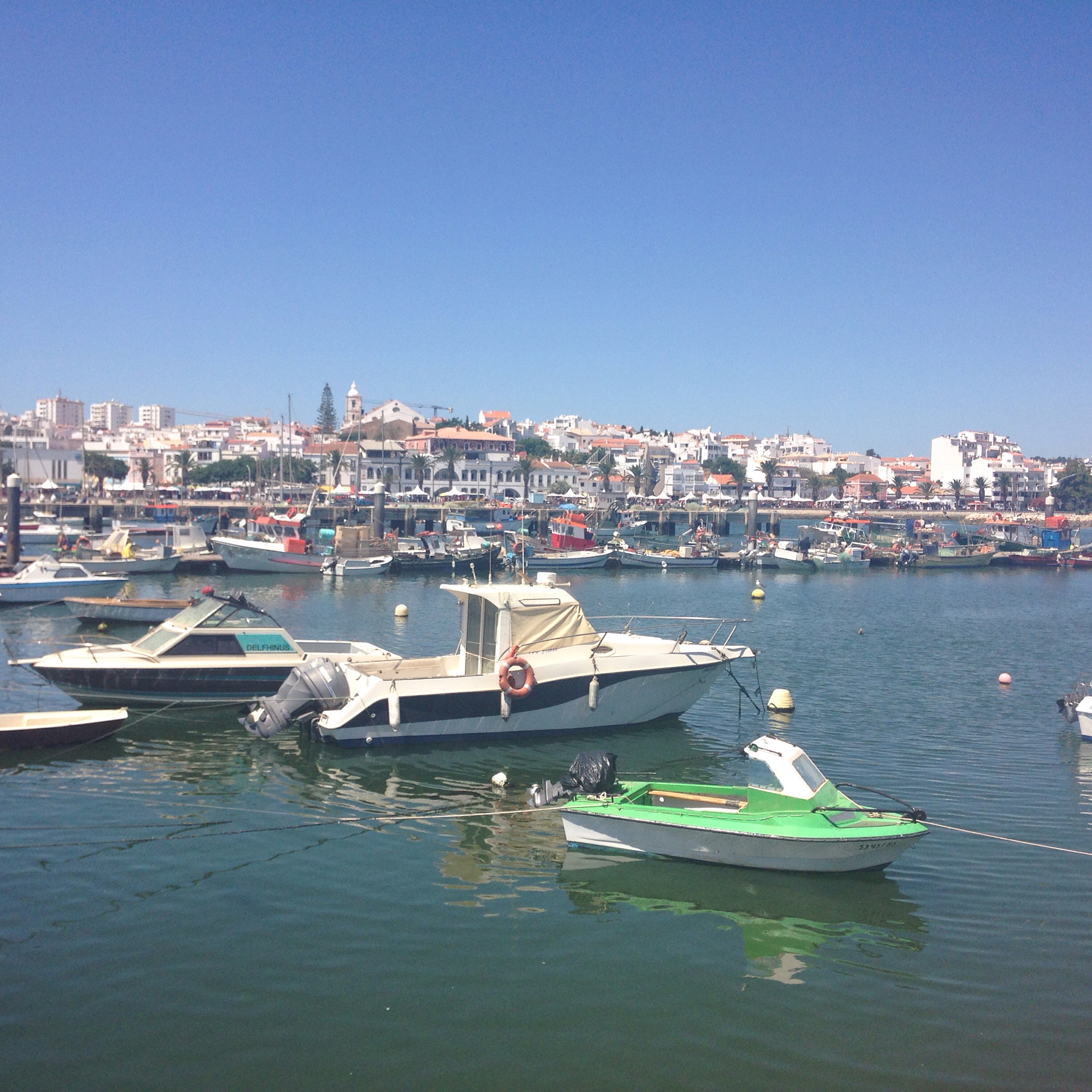
The House on the Hill is the third in my Portuguese Paradise series of books. Set in Lagos in the Algarve, it’s about Layla Garcia who runs a yoga and mindfulness studio in the hills above the city. Her apparently well-organised and calm life is knocked sideways when she gets a new neighbour who reminds her of a bit of her past she’d rather forget. 

When I wrote The House That Alice Built, which was the first in the series, I wrote it as a stand-alone. I had no plans to continue Alice’s story on, as my main focus was to actually finish writing the book, which took me 8 years from when I first started it to actually getting it published.

I had fully intended to start on my next novel, which was to be Finding Summer Happiness and set in Wales rather than Portugal, but I felt Alice’s story hadn’t really finished. So, I began to formulate the plot for New Beginnings at the Little House in the Sun. In some ways, it wasn’t too difficult – after all, I had the characters and the beautiful setting of Cascais; but I needed to give Alice another challenge or two before she could really be happy, and that took a little while for me to work out. Once I’d realised what hurdles she needed to overcome, however, I found it quite easy to do. I had to decide which characters didn’t need to return, invent a few more, and formulate a way to bring everyone together in the end. 

I also took the story to Lisbon more and also over the River Tejo southwards, which is a beautiful part of the world, so enjoyed revisiting that in my memory too. A long weekend in Lisbon gave me a well-needed burst of energy and I finished the book soon after that, and, rather quickly, the second in the series was done.

Was there more to say for Alice and her friends? I didn’t think so, and therefore began work on Finding Summer Happiness, turning my attention to Pembrokeshire with other characters and new dilemmas.

I couldn’t really let Portugal go, though, and during the period of the pandemic when I couldn’t visit my beloved Lagos in the Algarve, the idea for a story set there began to find its way steadily into my mind. I wanted to connect it to the first two, but had a whole new set of characters I wanted to spend time with, and so spent a few weeks deciding whose story needed a little bit more attention from the first two books. I’m not giving anything away, but someone has travelled down to Lagos and spent time with Layla and her friends, and has a little storyline of their own. There are also a few tiny cameos along the way, too.

I had great fun dotting in references here and there about the first two novels and some of the people in them, so that anyone who has read them can enjoy a knowing smile or two. But for those who are new to the books, they wouldn’t know, so it can be enjoyed as a story on its own.

What’s common to all of them is Portugal, of course, and once again I have immersed myself in the beauty, vibrancy, colour and warmth of the country and hopefully that has come across in the new book. Layla looks down from her 'House on the Hill' to the long, golden sands of Meia Praia, with the lagoon at one end and the city at the other, and drives down into Lagos for work, or food, or even a ride on the road train. The research into all of this was very, very rigorous, I must say, and I’m more than happy to do it again. So, although I’m now writing something different, Portugal is always calling, so I’m sure there’ll be a Portuguese Paradise book 4 in the not too distant future.

Thank you, Chris. It's interesting that you couldn't let Portugal go. For me, setting plays an important part in a story and it's clear that your love of the country shines through in your books. I wish you every success with Book 3 of the series.

BLURB: 

The House on the Hill: A Summer in the Algarve (Portuguese Paradise Book 3) 

Layla is calm, in control, and is definitely not about to lose her serenity for the man next door!

Surely it can’t be hard to stay peaceful at one of the oldest yoga and mindfulness retreats in the Algarve, surrounded by sea, sun and serenity? Mostly, owner Layla Garcia manages it – with the help of meditation and plenty of camomile tea, of course.

But keeping her grandparents’ legacy alive is stressful and Layla has become so shackled to the work, that for her, the ‘house on the Hill’ is fast becoming ‘The Fortress on the Hill’.

Then writer Luke Mackie moves to the villa next door, bringing with him a healthy dose of chaos to disrupt Layla’s plans, plus a painful reminder of a time when she was less-than-serene. But could his influence be just what Layla needs to ‘dance like no one’s watching’ and have the fun she’s been missing?

Buying link here: smarturl.it/x4u6oz

BIO:

Chris won the 2019 Choc Lit Search for a Star competition, sponsored by Your Cat Magazine, for her debut novel, The House that Alice Built. The sequel, New Beginnings at the Little House in the Sun, was published in August 2020. Both are available in paperback, e-book and audio and are part of the Portuguese Paradise series. Finding Happiness, set in Pembrokeshire in South West Wales, is available in e-book, audio and paperback. The house on the Hill - A Summer in the Algarve, the third novel in the Portuguese Paradise series, is published in e-book on 28th June 2022. 

Chris is an author and freelance radio producer for BBC Local Radio. She also has her own podcast - The Talking to My Friends About Books Podcast - where she chats to her friends about books. Good title!

A lover of books, music and cats, she is also an enthusiastic salsa dancer, a keen cook and loves to travel. She is never happier than when she is gazing at the sea.

SOCIAL MEDIA LINKS:

Twitter: @ChrisPenhall

Instagram: christinepenhall

Facebook: Chris Penhall Author

Thank you for reading. I hope you enjoyed finding out about Chris and her Portuguese series as much as I did. What do you like about reading novels in a series? Why not share your thoughts in a comment? Thank you.

You may also follow me on Twitter @JanBaynham and on my Jan Baynham Writer page. 

To find out more about me and my novels, please visit my AMAZON page.


Monday, 23 May 2022

 A Virtual Writing Retreat

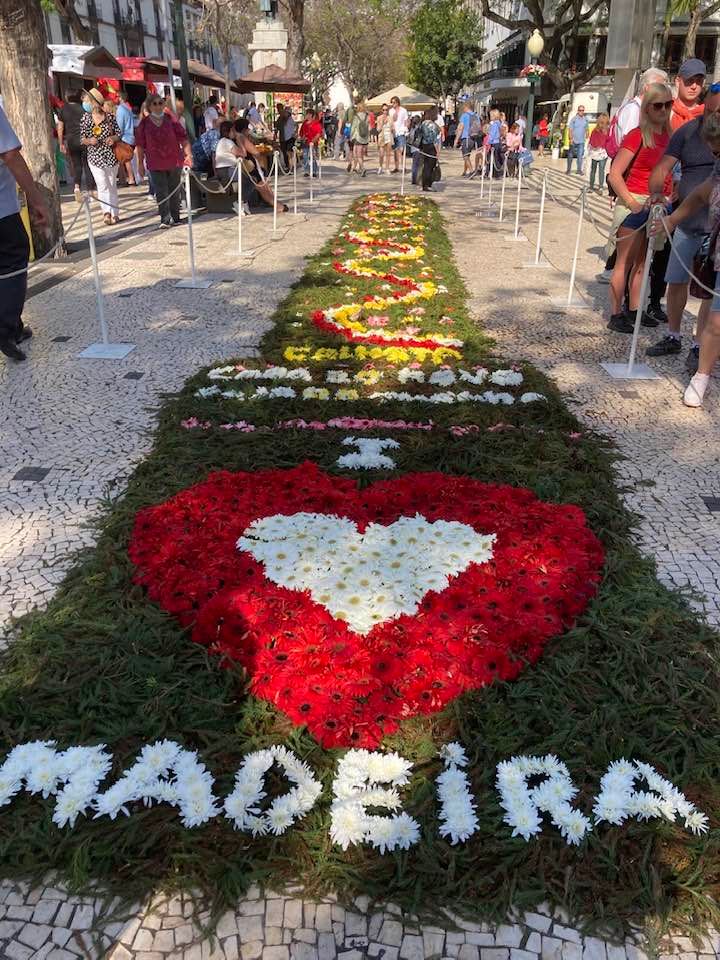
Back from a wonderful holiday in Madeira for the flower festival, I was very much in need of a boost to get back to novel four after not having written anything for a few weeks. Back in February, our Cariad Chapter held its first virtual writing retreat, led by our lovely Jessie Cahalin. We all agreed it was a huge success with members achieving what they'd planned to do. From a personal point of view, I felt I gained not just from the words written but in my state of mind regarding writing in general. I felt enthused again after some time in the doldrums and feeling a bit rubbish! When I knew we were going to spend another day with Jessie, I wondered if it would have the same motivating effect on me as the first one.

I'd spent the previous day mapping out some scenes in my character, Claudia's, viewpoint so that I would be ready to start writing straight away. Because the novel is another dual timeline and there are two stories, it's important for me to plan in some detail. That doesn't mean that things don't change and characters act and think in a way I wasn't expecting but for me the planning is important. I also decided to take on a Nano 'don't get it right, get it written' approach. It does mean more editing for me later but it helps me get fully immersed in the story. Each time I came across something that would need researching, I would insert a comment with notes of what was needed so that I didn't veer away from the writing. So, did it work out? How was the day for me?

On the morning of May 17th, we met together with Jessie via Zoom at 9am. and shared our plans for the day. I had no idea how many words I would write but as long as I moved the story on, I would be happy. Referring to my planned scenes proved invaluable. We met again at 12 noon to report progress before a lunch break and I was pleased to find I had written over 1300 words. By the close of the retreat at 5pm, my novel stood at 23,409 words after starting at 20,018. Not a huge amount for some writers but I was pleased I had stayed focused - no procrastination - and best of all, I'd enjoyed getting back in my characters' company again. A spin-off to the success of the day was that I continued writing each day afterwards. The WiP now has a working title, 'A Tale of Two Sisters'. I know that will probably change but having a title seems to make the manuscript more real as opposed to just calling it 'novel four'.

I reflected back on the day and asked myself why do retreat days work so well for me.? Here are some of my thoughts:

  • I've stated my plans for the day in front of my fellow writers
  • by setting aside uninterrupted time, I have no excuse to get distracted especially by social media
  • I write without researching or editing
  • knowing that others are writing at the same time and reporting back to each other at certain times is motivating
  • if I hit a character or plot problem, I'm able to discuss it with others in the group

I'm much more positive about the new novel now. It will need a lot of work, of course, but isn't that what writing a novel is all about? Since I last talked about the novel, I have booked a research trip with my daughter to Sicily. We are flying into Catania which we will use as a base for visiting places of interest in Taormina and Syracusa. By then, I hope to have researched where and what we want to see as it is only a five-day trip. I hope that when and if  'A Tale of Two Sisters' is published early next year, readers will be able to walk in the footsteps of 
the characters, taste the food and drink and experience the climate.

Thank you for reading. What do you think are the benefits of a virtual writing retreat? I'd love to hear your thoughts. Thank you.

You may also follow me on Twitter @JanBaynham and on my Jan Baynham Writer Facebook page.

To find out more about me and my books, please visit my AMAZON page. 


Saturday, 23 April 2022

 A Relaxing Time in Los Gigantes

One view from our balcony
At the end of March, we travelled to our favourite corner of Tenerife for an eleven-day holiday hoping for some sunshine after the Welsh winter. Los Gigantes is a resort town in the Santiago del Teide municipality on the west coast of the largest Canary Island. Its main feature is an array of giant rock formations, Acantilados de Los Gigantes, that rise from the sea to a height of 500 -800 metres and give the town its name. Los Gigantes means 'The Giants'. The first time we visited the town coincided with the annual four-day Carnival. Described as 'a riot of colour... (with) fancy dress competitions, dancing and processions...The burial of the sardine marks the end of the fiesta." Watching the festivities from our balcony inspired me to write a short story about a little girl lost in the crowds. It's entitled 'Burning Our Sardine' and appears in my collection of short stories, Smashing the Mask and Other Stories.

One strikingly beautiful dancer dressed head to toe in bright turquoise made her way to our side of the street and made eye contact with me. The sequins on her leotard glinted in the bright sunshine and accentuated the curves on her slim but shapely body. Huge aquamarine feathers plumed her head and shoulders, forming wings. I smiled back at her as she moved her neck and arms as if she was a performing a dancing ritual to attract a mate.
    “I’m back. Where’s Mia?” Lucy’s concerned voice brought me back to the present. 
    “She’s watching from the front,” I said, looking towards the place where our daughter had been standing moments before. I went cold. Goosebumps formed along my neck as I realised she’d gone.


Because of COVID, this year's Carnival has been postponed to later in the year but we did have a troupe of 
colourful dancers visit the hotel in a practice run.

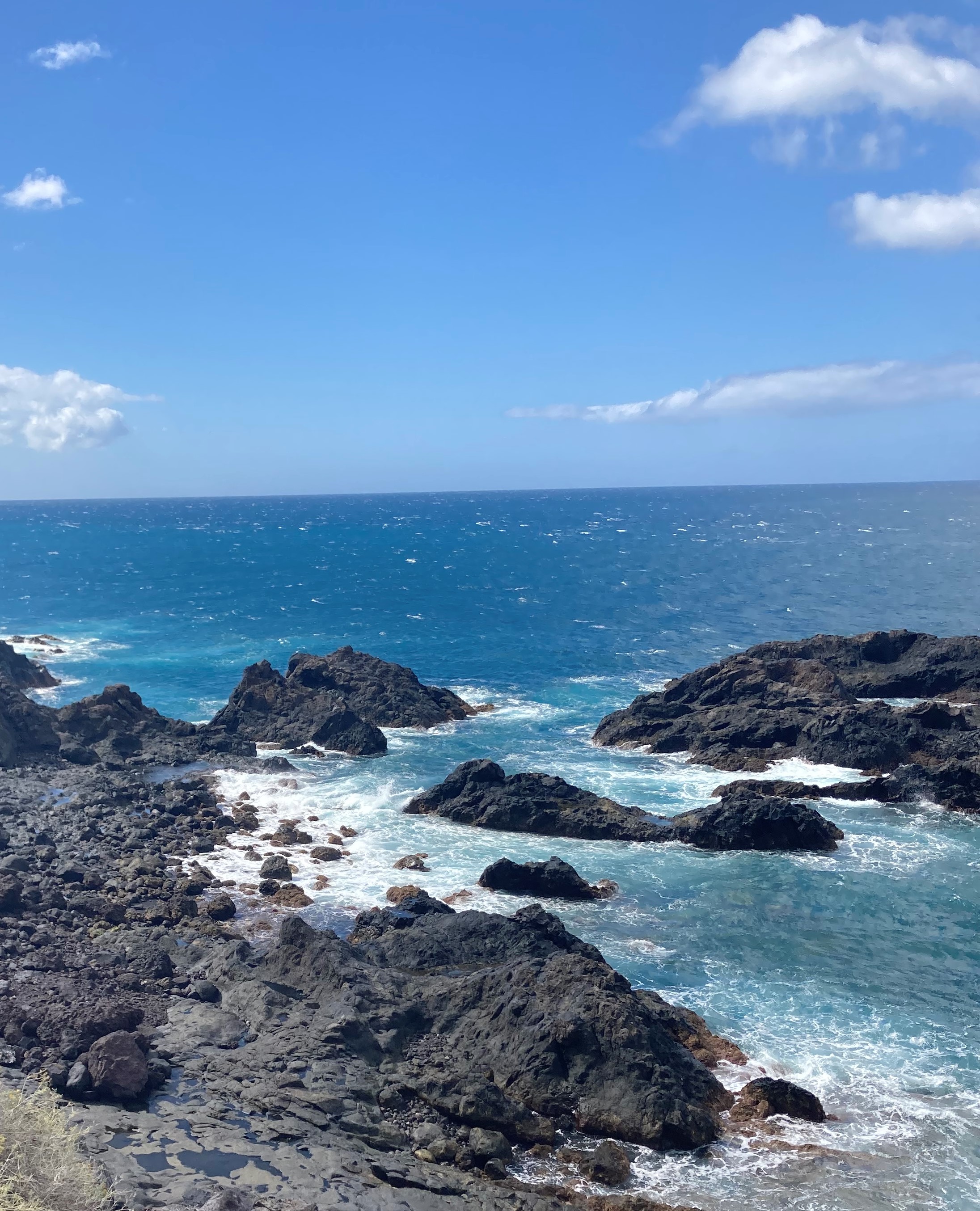
Although the sun was hot and shone as brightly as we'd hoped, there was sometimes a strong wind. The dramatic coastline with the sea pounding on the rocks was quite a spectacle on our walks. 

For me, a relaxing holiday like this means plenty of time for reading. I like nothing more than to escape through an author's words and lose myself in the worlds they have created. I'm always drawn to dual time-line novels and especially ones where the reader is taken to another country. One novel that stood out for me was 'The Postcard from Italy' by Angela Petch. It's a beautifully crafted novel where I'm transported to Puglia to sample life in the 1940s as well as the present day. I felt I was there in Italy with the characters. The heartbreaking yet uplifting story captivated me from beginning to end.

The other novel I want to mention is 'The Olive Grove' by Eva Glyn. Not a dual time-line as such, the novel opens in 1996 but the rest of the story is set in 2019. However, there are frequent references to events in the past as we get to know the character of Damir. The wonderful sense of place is almost a character in its own right. I was taken straight to Croatia, marvelling at the views and getting to know about the Croatian way of life. A poignant, emotional novel, its characters were with me long after I finished reading it.  

Thank you for reading. What novels do you like to read on holiday? I'd love it if you left a comment. Thank you.

You may also follow me on Twitter @JanBaynham and on my Jan Baynham Writer Facebook page. 

For more about me and my books, please visit my AMAZON page. 


Monday, 14 March 2022

 Writing Novel Four

The last time I wrote a post about novel four was when I was at the planning and research stage. One of the things I realised was that both those stages could go on forever and I needed to start writing it. The James Thurber quote, 'Don't get it right, get it written', became more important than ever. 

Back at the beginning of February, a member of the Cariad RNA Chapter of which I'm a co-organiser, the lovely Jessie Cahalin, offered to run a Virtual Writing Retreat via Zoom. Members met at 9am to say what their plans and aims were for the day, met back at lunchtime and finally congregated at 5pm to review the day and celebrate each others' achievements. Some people used the time to write, others to edit or plan; some people came for part of the day. From everyone's feedback, it was a huge success. I had started writing the novel beforehand, but being totally immersed in the story for the whole day was just the kick-start I needed. Thank you, Jessie.

Since then, I have tried to write whenever I can and I am now over twelve thousand words into the story. Some things have changed. The husband of my main character, Sara, was called Alwyn and their son is Aled! I've kept the little boy's name, but Alwyn is now Fred, a common name during the 1940s. I have a new character, too. Jane Lewis, Sara's mother-in-law, now has a sister Gwen who was needed to show Sara kindness and support as a complete contrast to the character of Jane. One of Fred's previous girlfriends also now has a role. Babs is as streetwise as Sara is innocent 

Although writing the story is my priority at the moment, it doesn't mean that finding out about the Italian POWS and Sicily itself has stopped. I follow a wonderful blog White Almond Sicily run by a British woman, Sarah Kearney. As an introduction to her blog, Sarah writes: 'My love for Sicily inspired me to write a blog sharing travel tips and advice, Sicilian food tips and living life "The Sicilian Way", writing in a fun and visual way to encourage more visitors to the island...' There is always something to learn from her posts and the photography is wonderful, 'whether you are a lover of art, history, mythology, food, vineyards or literary, walking and hiking or just a sun worshipper of beautiful beaches with lazy days on board a yacht.' Sarah very kindly chose my second novel, Her Sister's Secret, as one of twelve novels set in Sicily. My daughter, Jo, and I are hoping to visit Sicily on a research trip in the next month or so and I shall be contacting Sarah for advice on the best places to visit as she has offered.

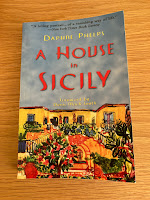
On Friday, I shall be travelling to Los Gigantes in Tenerife for an eleven-day holiday. I shall;l be packing my notebook and hope to get some writing done. As well as having my KIndle jammed full of novels I can't wait to read, I shall be taking this wonderful-looking book by Daphne Phelps. It was recommended by Sarah on her blog. She bought it on her first-ever visit to Sicily. She describes how she loved '...the way (Phelps) wrote about her life in Taormina with its colourful characters and visitors... and living life the Sicilian way.' 

She goes on to say:
'Casa Cuseni is an enchanting villa that was designed and built fo9r the English painter, Hawthorn Kitson in 1905. His Taorinese house and its lush gardens were designed in an art nouveau way mixed with Sicilian influences.

After his death, Daphne inherited Casa Cuseni and in order to sustain the enormous cost of the house, she started to rent out a few of the rooms to illustrious guests who came to write and paint.'

Thank you for reading. Can you recommend any books set in Sicily? I'd love to know what they are. 

You may also follow me on Twitter @JanBaynham and on my Jan Baynham Writer Facebook page.

For more about me and my books, please visit my AMAZON page.